Mathematics is one of those subjects in Railway exams where knowing the formula is only half the preparation. The real difference often comes from how quickly and accurately you can apply that formula. That is why a good question-practice book can be useful, especially when you are preparing for exams such as RRB NTPC, Group D, ALP, Technician, RPF and RRB JE.
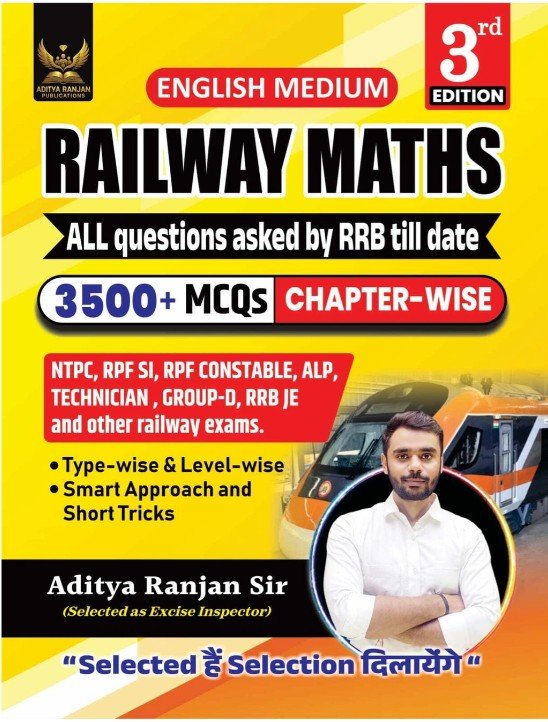
The Railway Maths 3rd Edition by Aditya Ranjan 3500+ Mcq Book PDF is focused mainly on this aspect of preparation. The book is designed around a large collection of questions and is intended for students who want to practice Mathematics in a more structured way.
The cover mentions 3500+ chapter-wise MCQs, along with questions asked by RRB over the years. It also highlights a type-wise and level-wise approach and the use of smart methods and short tricks.
What makes Railway Maths 3rd Edition different?
The first thing I noticed about this book is that it is not trying to be a general Mathematics textbook. Its approach is much more practice-oriented.
For a Railway aspirant, this can actually be helpful. After completing a topic from your regular study material, you need enough questions to understand whether you can solve different variations of that topic under exam conditions.
Instead of picking questions randomly, the book allows you to work through Mathematics chapter by chapter.
This makes it easier to follow a routine such as:
Learn the concept → Solve basic questions → Practice different patterns → Improve speed → Revise mistakes
That kind of sequence is more useful than simply trying to finish a large number of questions without analysing them.
3500+ MCQs for regular practice
The biggest attraction of the book is its 3500+ MCQs.
For competitive examinations, repeated practice matters because Mathematics questions may look different on the surface while testing a similar underlying concept. Solving a variety of questions helps you recognise these patterns more quickly.
The chapter-wise arrangement is particularly useful when you are still completing the syllabus. You can select one topic, solve its questions and keep track of the mistakes you are making.
Later, the same collection can be used for revision.
Previous RRB questions are an important part
The book specifically mentions questions asked by RRB till date. For a Railway aspirant, this is an important feature because previous examination questions give a better idea of the type of Mathematics questions that candidates may encounter.
Rather than preparing every possible type of question with equal priority, students can use previous questions to understand:
- Which concepts are repeatedly tested
- What type of calculation is expected
- Which topics require more practice
- Where time is usually lost
- How questions are framed in Railway examinations
I would recommend solving these questions seriously instead of treating them simply as another practice set.
Type-wise and level-wise preparation
Another useful feature highlighted in the book is type-wise and level-wise practice.
This is something many students overlook. If you immediately start solving difficult questions without becoming comfortable with the basic patterns, Mathematics can start feeling unnecessarily complicated.
A better approach is to move gradually from familiar question types to more challenging ones.
Once a student becomes comfortable with a particular pattern, the focus should shift towards speed and accuracy.


Reviews
There are no reviews yet.