Geography stands as one of the absolute foundational pillars of the UPSC Civil Services Examination. Its relevance stretches far beyond the boundaries of standard static mapping, embedding itself directly into General Studies Paper I (Physical, Human, and World Geography), Paper III (Environment, Disaster Management, Agriculture, and Economic Development), Essay writing, and dynamic Current Affairs. Developing a robust geographical perspective enables aspirants to seamlessly connect physical phenomenon with economic policies, environmental challenges, and socio-political realities.
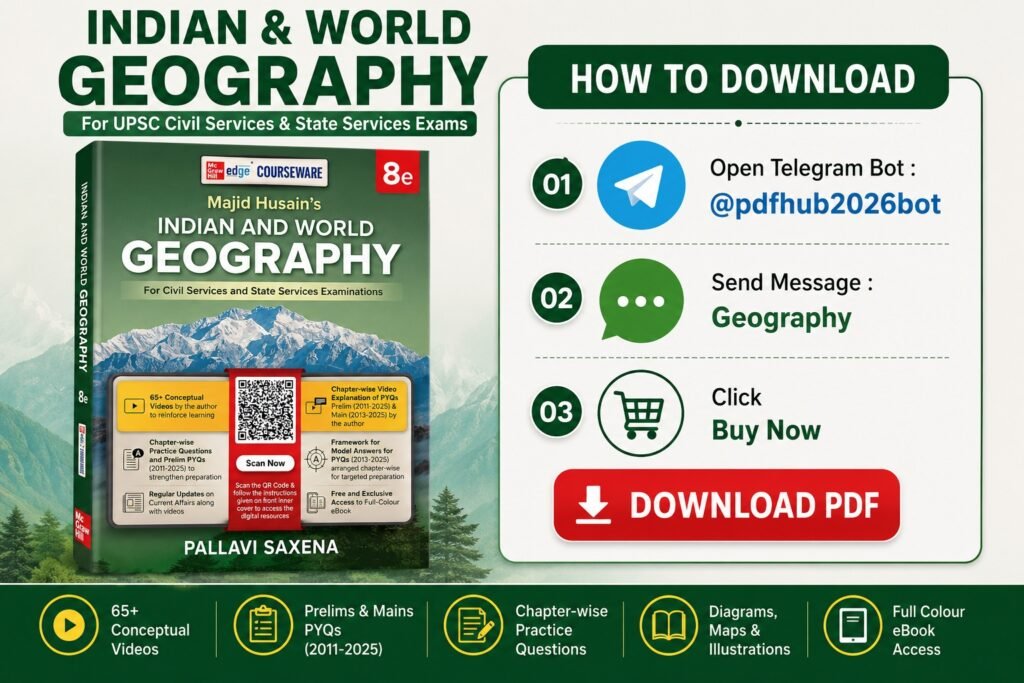
To streamline preparation and provide a comprehensive learning roadmap, Indian & World Geography (8th Edition) by Pallavi Saxena has established itself as an essential multi-format courseware tailored specifically for competitive examinations like the UPSC CSE and various State Public Service Commissions.
About the Book and Modern Learning Integration
The 8th edition bridges the gap between conventional textbook reading and modern multimedia learning tools. Recognizing that traditional text alone often falls short when tackling dynamic physical and economic geography concepts, this publication integrates physical theory with digital resources.
The comprehensive package includes:
- 65+ Author-Led Conceptual Videos: Visualizing tectonic shifts, ocean currents, and atmospheric circulation becomes significantly easier with direct digital walk-throughs.
- Integrated PYQ Archives: Complete tracking of historical trends through authentic question sets.
- Mapping and Visual Frameworks: Detailed diagrams, data charts, and cartographic illustrations.
- Current Affairs Alignment: Static concepts continuously mapped against emerging environmental and developmental realities.
Detailed Subject Scope and Core Chapters
The book adopts a structured approach, dividing the vast expanse of geography into distinct, manageable segments:
- Physical Geography: Covers geomorphology (origin of the earth, earth’s interior, rock systems, volcanism, earthquakes, and landform evolution), climatology (atmospheric layers, global wind systems, monsoons, and weather phenomena), and oceanography (ocean relief, currents, and marine resource distribution).
- Indian Geography: Focuses heavily on the physiography of India, drainage systems and river networks, agricultural patterns, industrial corridors, natural resource distribution, and demographic profiles.
- World Geography: Examines major continental layouts, regional geography, global mountain ranges, international river systems, and world climate zones.
- Human and Economic Geography: Analyzes population growth, migration trends, urbanization challenges, human development indices, and resource economics.
- Environmental Geography: Integrates biodiversity protection, ecosystem dynamics, climate change negotiations, and national/international conservation frameworks.
Why Geography Holds High Scoring Potential in UPSC
For both Prelims and Mains, mastering geography yields high returns on invested study time due to its direct overlap with other syllabus components:
- In UPSC Prelims: Questions frequently test conceptual understanding coupled with map-based locations, such as national parks, river basins, mineral-rich zones, straits, and international borders.
- In UPSC Mains: Answers on agricultural crises, industrial location factors, disaster management responses (like cloudbursts or landslides), and geopolitical shifts require strong geographical grounding to score high marks.
Key Pedagogical Features
- Extensive PYQ Coverage: Integrates UPSC Prelims previous year questions alongside Mains questions. This dual exposure trains aspirants to shift seamlessly from objective elimination techniques to analytical, structured answer writing.
- Model Answer Frameworks: For Mains candidates, the book offers structured guidelines on how to incorporate maps, diagrams, and statistical data into daily answer writing practice to maximize scores.
- Chapter-Wise Self-Assessment: Targeted practice questions at the end of each chapter ensure immediate revision and retention testing.
Strategic Approach to Studying Geography
To extract maximum value from this resource, aspirants can follow a structured 5-step strategy:
- Master Physical Foundations First: Build clear conceptual clarity on geomorphology and climatology before moving into Indian and World regional geography.
- Embrace Visual Learning: Never read geographical phenomena purely textually; simultaneously consult maps and digital video modules to cement mental images.
- Integrate Daily Mapping: Practice marking important geographical coordinates regularly to secure objective-type questions in the Prelims.
- Link with Current Events: Bridge static chapters like monsoons or energy resources with contemporary news developments, such as El Niño impacts or green energy transitions.
- Consistent Revision: Formulate crisp, one-page summary notes for quick final-hour pre-exam reviews.
Final Verdict
Whether you are a beginner stepping into civil services preparation or a seasoned aspirant looking to refine your core optional and GS foundations, Indian & World Geography by Pallavi Saxena (8th Edition) serves as a reliable, all-inclusive academic companion. When combined with regular answer writing, newspaper analysis, and rigorous map practice, this book provides the necessary depth to successfully navigate the evolving demands of the UPSC examination.

| Our Website | Click here |
| Download Upsc Books | Click here |