English vocabulary can become a surprisingly difficult part of competitive exam preparation. The problem is usually not finding a list of difficult words; it is knowing which words are actually relevant for the examination and how often they have appeared in previous papers.
This is the area where The Blackbook of English Vocabulary by Nikhil Gupta has become a popular resource among students preparing for SSC and other competitive examinations.
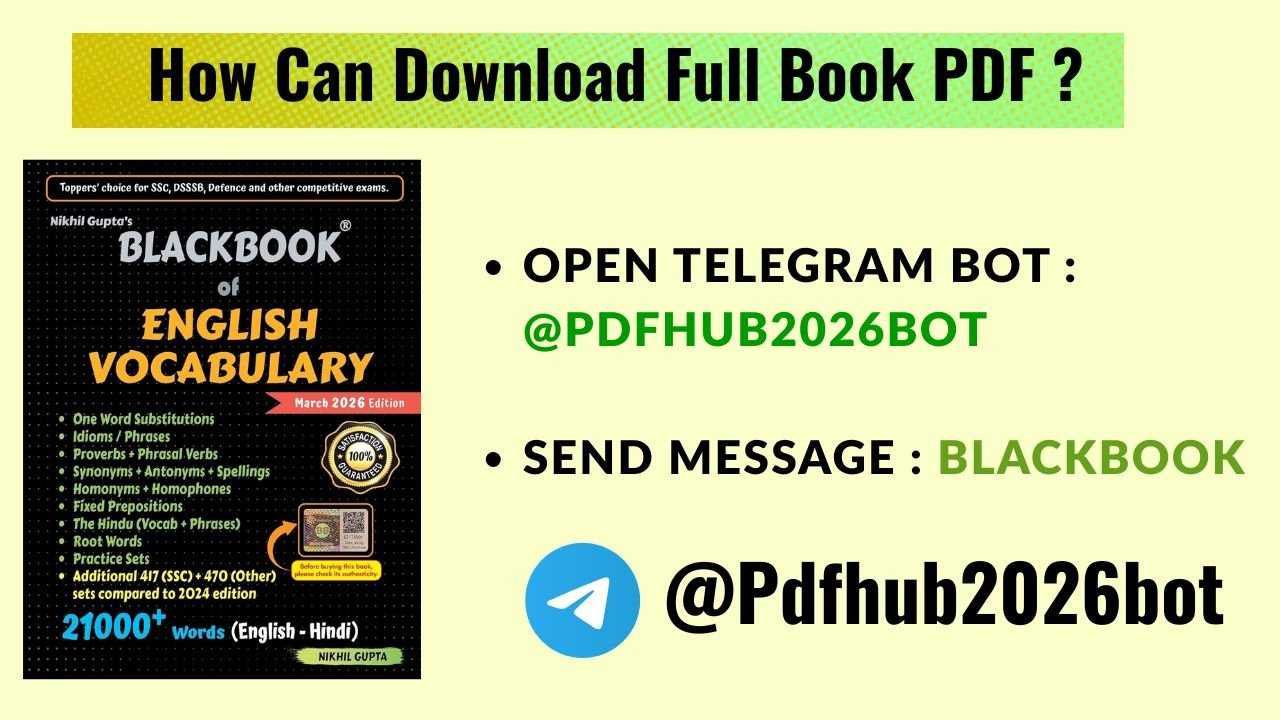
The 2026 edition (4th edition) is presented as an updated version with vocabulary collected from examination papers and additional material for practice. According to the book information provided, this edition includes vocabulary from SSC papers up to February 2026, along with several new sections.
If you are considering this book for your English preparation, the important question is not simply how many words it contains. The more useful question is whether its approach fits the way you are preparing for your exam.
What is Blackbook of English Vocabulary?
The Blackbook is a bilingual English-Hindi vocabulary resource aimed at competitive examination aspirants.
Rather than presenting vocabulary as a general English dictionary, the book focuses on words and expressions relevant to competitive exams. The material includes meanings, vocabulary-based questions and different sections covering areas such as synonyms, antonyms, idioms and phrases, one-word substitutions and other commonly tested topics.
The 2026 edition is described as containing 21,000+ words, with English definitions and Hindi meanings.
For Hindi-medium students, this bilingual presentation can make the initial understanding of unfamiliar words easier.
Why is this book popular among SSC aspirants?
The main attraction is its exam-oriented approach.
When preparing vocabulary, students often make one of two mistakes. Either they try to memorise random word lists, or they spend too much time learning words that have little connection with the examination they are targeting.
The Blackbook takes a different approach by organising vocabulary around words appearing in competitive examinations.
The book information also mentions vocabulary taken from SSC examinations since 1997. For an SSC aspirant, previous examination vocabulary can be more useful than simply studying difficult words without knowing their exam relevance.
21,000+ Words – Is More Always Better?
The number of words mentioned for the book is certainly large, but students should not interpret that as a requirement to memorise everything at once.
Vocabulary works better when it is studied in stages.
For example, a student preparing for SSC can first concentrate on frequently appearing words, then gradually move towards less frequent vocabulary. Regular revision is more important than trying to complete hundreds of words in a single day.
The book’s frequency indicator (#R system) can be useful in this regard because it gives students a way to prioritise words rather than treating every word as equally important.
That is probably one of the more practical features for students who have limited preparation time.
What topics are covered?
The book covers several areas that are commonly relevant to English sections of competitive examinations.
These include:
- Synonyms and Antonyms
- One Word Substitution
- Idioms and Phrases
- Proverbs
- Phrasal Verbs
- Spelling Correction
- Homonyms and Homophones
- Fixed Prepositions
- Root Words
- Prefixes and Suffixes
- Vocabulary from The Hindu Editorial
The book also includes 24 specialised wordlists, English definitions with Hindi meanings and practice sets.
This variety means the book can be used for more than just learning isolated word meanings.
What is new in the 2026 Edition?
The 4th edition includes several additions according to the book details provided.
The new material includes:
- 887 new exam papers
- 417 SSC shifts
- 470 other exam papers
- A new section on Fixed Prepositions
- A new section on Homonyms
- Additional vocabulary
- An improved frequency marking system
- English definitions for better understanding
The inclusion of newer examination material is particularly relevant for students who want their preparation to reflect recent question trends.
How should you study the Blackbook?
This is probably more important than simply having the book.
Trying to memorise the entire vocabulary section in one go is unlikely to be effective. A better approach is to divide the material into smaller daily targets.
For example, you could begin with 20–30 words a day, depending on your current level.
While studying a word, don’t stop at its Hindi meaning. Try to remember:
Word → Meaning → Synonym/Antonym → Usage → Previous exam context
After two or three days, revise the earlier words before adding new ones.
This repeated exposure is what eventually turns a word from something you have “seen” into something you can actually recognise in an examination.
Who can benefit from this book?
The book is particularly relevant for students preparing for:
- SSC CGL
- SSC CHSL
- SSC MTS
- SSC CPO
- SSC Stenographer
- DSSSB examinations
- Banking examinations
- Defence examinations such as NDA, CDS and AFCAT
- Other competitive examinations where English vocabulary is tested
The exact usefulness will naturally depend on the syllabus and English section of the examination you are preparing for.
A practical way to use it for SSC
If SSC is your main target, I would not recommend treating the book as something that needs to be completed from the first page to the last page as quickly as possible.
Instead, divide your preparation into three parts.
First: Build your vocabulary base
Start with frequently occurring words and basic synonyms, antonyms and one-word substitutions.
Second: Add exam-specific vocabulary
Move towards words that have appeared in previous examination papers. Pay attention to words that you repeatedly encounter.
Third: Revision and testing
Use the practice sets and regularly test yourself without looking at the meanings.
The objective should eventually be to recognise the word within a question, rather than merely remembering its Hindi translation.
Is Blackbook of English Vocabulary worth using?
For students who specifically need an exam-focused vocabulary resource, the book has several useful features.
Its large vocabulary collection, bilingual presentation, frequency indicators, previous examination-based material and practice sections give it a clear competitive-exam orientation.
At the same time, vocabulary should not be prepared in isolation. For SSC, it should be combined with reading comprehension, grammar, previous-year questions and mock tests.
A student who knows thousands of word meanings but struggles to understand a passage or apply grammar rules will still have gaps in English preparation.
So the book works best as one part of a broader English strategy.
Final Review
The Blackbook of English Vocabulary 2026 Edition by Nikhil Gupta is primarily useful because it tries to answer a practical problem faced by competitive-exam students: What vocabulary should I actually study?
Its focus on examination-based vocabulary, frequency indicators and recent additions makes it particularly relevant for students preparing for SSC examinations.
The 21,000+ words may initially look overwhelming, but the book becomes much more manageable when used selectively and revised regularly. Instead of chasing a daily target simply to finish the book, students should focus on remembering words and recognising them when they appear in actual questions.
For an SSC aspirant who is looking for a dedicated vocabulary resource, the 2026 4th Edition is worth considering, especially when used alongside previous-year papers and regular English practice.
📌 How to Get the Book
If you are looking for the book online, it is better to use a legitimate source or purchase the original edition so that you receive the complete and updated material.
If you already have access to the book through a legitimate digital source, you can use it alongside your regular SSC preparation and follow a daily vocabulary-and-revision routine.
| UPSC Official Website | Click Here |
| Download Notes | Click Here |
student
akshayapb77@gmail.com
Good 👍
Good
This a very great book. Iam very happy because I have this book